We have done our best to integrate our homeschool curriculum. The initial rationale for integration came from comments made by my previous students – why are we doing this? how does this relate to my other classes? how does this relate to real life? One student even said, “I haven’t learned anything relevant before, why would this class be any different?” So, as an educator, I have always made a point to connect the concepts in my current classes to previous classes, to current events, or to future work situations. I knew the research showing how integrating the curriculum “enhances motivation, problem-solving skills, content knowledge, and deeper understanding of connections across subjects” (Vega, 2013). But at the college level, I only focus on one discipline. How was I to integrate a fourth grade curriculum that included more than six subject areas?
To answer that question, I needed to further explore the definitions of integrated curriculum. My initial search led me to ASCD’s website (the Association for Supervision and Curriculum Development) and a review of the book Meeting Standards through Integrated Curriculum (Drake and Burns, 2004). In the book, integrated curriculum was simply “about making connections” (Drake and Burns, 2004). An Edutopia Research Review went further to say that “integrated studies involve the combination of two or more subjects in a lesson, project, classroom, or curriculum” (Vega, 2013). Finally, a report from the Nebraska Department of Education described integrated curriculum as “learning that is synthesized across traditional subject areas and learning experiences that are designed to be mutually reinforcing.” In summary, integrated curriculum develops a student’s ability to connect and transfer learning to other settings.
Connected learning is brain building (NE DOE). The more connections made by the brain, the greater the opportunity for making high level inferences … that wonderful process of gathering and sorting information to draw conclusions. Inferences are the ultimate example of a “21st Century Skill” (OECD, 2008) that helps students to more easily move from concrete to abstract thinking. Connected learning is also developmentally appropriate (NE DOE). Children live in a connected world. Individuals are shaped by their family, the family is influenced by their community, and the community is affected by the larger society. Children live holistically; they should learn holistically. But I didn’t yet know how to do that with multiple subjects.
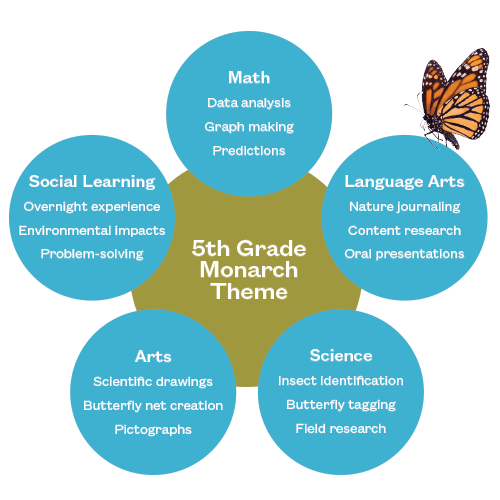
But then I discovered a wonderful graphic from The College School showing how content is drawn from several subject areas to focus on a particular topic or theme. This made sense to me, particularly as we entered units on Historical Fiction, the Midwest States, and Ecosystems. I saw many ways to weave Language Arts, Socials Studies, and Science together and continued connecting topics for the remainder of the school year. (I have since learned that this is just one example of how to integrate the curriculum. See Drake and Burns (2004) for a further discussion of other approaches.)